 Harmonic Entanglement Theory
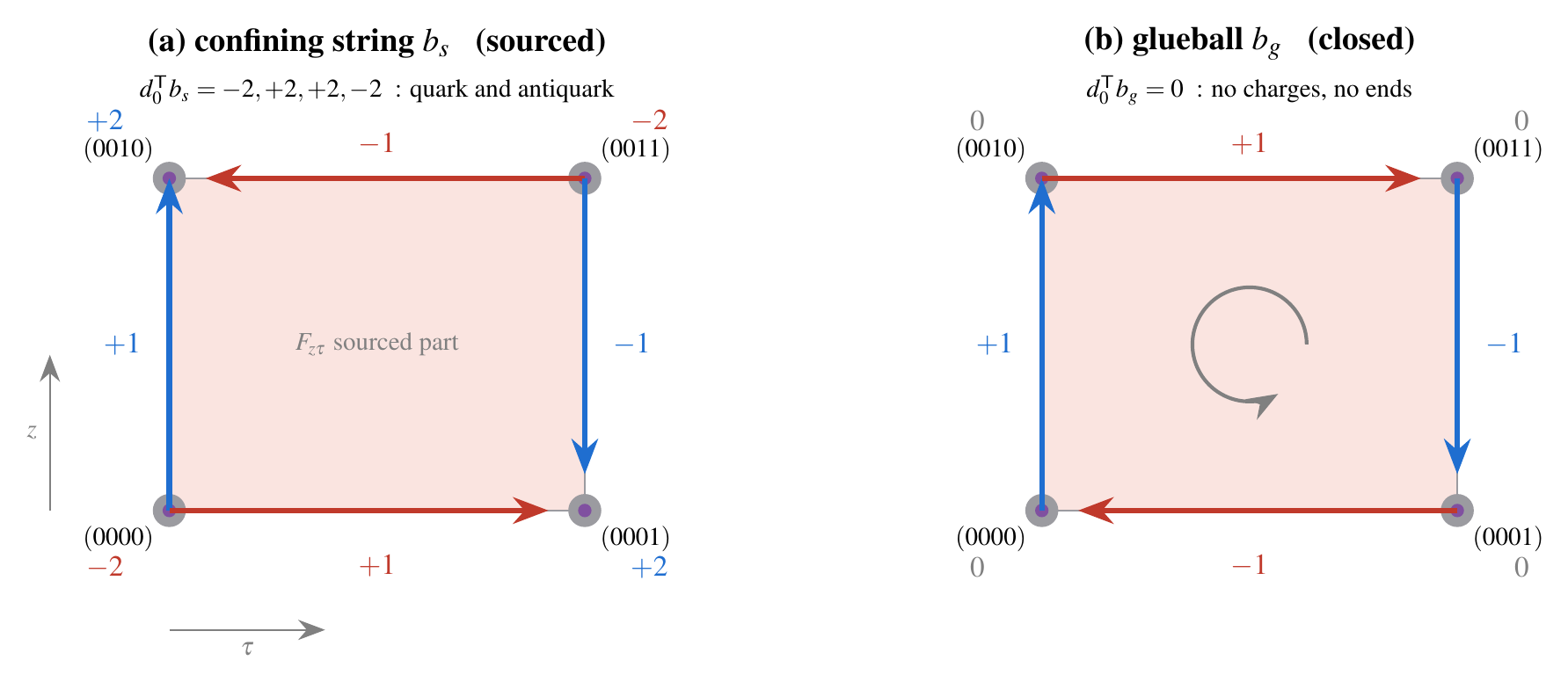
The colour flux on the prism
The colour flux is a vector on the colour edges. On the cube every vertex meets one z-edge, so closure forces \(b_{s}=0\) — no confining contour. The prism adds τ, opening the zτ-face, where the flux closes as the field strength Fzτ, an alternating four-cycle with \(|b_{s}|^{2}=4\).
Spectral decomposition over the edge operator
The flux spreads over the edge operator \(M_{1}=L_{1}+I\). Its projections give the propagator weight
\[ G_{b_s}=\frac{7/24}{1}+\frac{1/4}{5}+\frac{1/3}{7}+\frac{1/8}{9}=\frac{127}{315}=0.403175, \]
and the edge Sakharov trace, led by the seventeen zero-modes of the edge kernel, is
\[ \Sigma_E=\operatorname{Tr}M_{E}^{-1}=\frac{17}{1}+\frac43+\frac65+\frac47+\frac19=\frac{6368}{315}=20.21587, \]
\[ \Pi_{b_s}=\frac{G_{b_s}}{\Sigma_E}=\frac{127}{6368}=0.019943. \]
Closed flux on the same face
Where the string is the sourced part of the colour flux, the glueball is the closed part on the same face. Closure is the vanishing of the net flow at every vertex, \((d_{0}^{\mathsf T}b_{g})_{v}=0\), which is exactly the kernel of the edge operator: since \(L_{1}=d_{0}d_{0}^{\mathsf T}\),
\[ L_{E}b_g=0\quad\Longleftrightarrow\quad d_0^{\mathsf T}b_g=0. \]
The edge space splits into the seventeen-dimensional kernel of closed contours and the sourced eigenspaces \(\lambda=2,4,6,8\). On the prism only the zτ-face can carry a closed colour contour, the circulation \(b_g\). It lies entirely in the kernel, so its propagator weight is unity and
\[ G_{b_g}=1,\qquad \Pi_{b_g}=\frac{G_{b_g}}{\Sigma_E}=\frac{1}{\Sigma_E}=\frac{315}{6368}=0.049466. \]
The weight is unity for every element of the kernel, not for the face cycle alone, the projections being those of any closed contour.
Sourcedness fixes the trace
The representation factor Θ is the trace of the identity over the colour charge the object carries, over the channels it propagates through, and confinement decides which channels are open.
\[ \Theta_\psi=\frac11=1,\qquad \Theta_{b_s}=\frac38,\qquad \Theta_{b_g}=\frac14. \]
The confining string carries fundamental colour of dimension three, so it propagates through the adjoint octet of eight gluons, giving 3/8. The glueball is a colour singlet, and a singlet does not propagate through gluons, which confinement removes from the physical spectrum; its channels are hadronic. For the scalar there are four, the two-pseudoscalar channels of the light nonet, ππ, K̄K, ηη and ηη′, giving 1/4. The octet is internal to the construction, the colour assigned to the z-edges of the gauge sectors; the four hadronic channels are those of the light quark nonet and are not derived here.
The descent relation
Both objects are vectors on the edges, so the spectral weight enters squared, \(p=2\), and each is carried from the Planck scale to the infrared by the descent \(\exp(-1/\xi_{*})=\exp(-36)=2.31952\times10^{-16}\):
\[ \text{scale}=m_P\,\Theta\,\Pi^{\,p}\,e^{-1/\xi_{*}}. \]
With \(\Theta_{b_s}=3/8\) and \(\Pi_{b_s}=127/6368\),
and with \(\Theta_{b_g}=1/4\) and \(\Pi_{b_g}=315/6368\),