 Harmonic Entanglement Theory
Induced gravity on the prism
Gravity is induced, not fundamental. By Sakharov's mechanism a matter field on a fixed background is integrated out, and its vacuum fluctuations generate an Einstein–Hilbert term for the metric. Here the matter is the bond-oscillator scalar on the prism \(Q_4=Q_3\times I\), integrated out at the Planck-scale mass \(m=m_P\).
The modern heat-kernel form of the scalar Sakharov coefficient is
\[ \frac{1}{16\pi G_N}=\frac{1}{12}\int_{0}^{\infty}\!ds\int\!\frac{d^{4}k}{(2\pi)^{4}}\;e^{-s(k^{2}+m^{2})}. \]
The factor \(1/12\) is the standard scalar coefficient: \(1/2\) from the real-scalar one-loop determinant and \(1/6\) from the scalar curvature term in the heat-kernel coefficient. The proper-time integral gives the Euclidean momentum-space scalar propagator,
\[ \int_{0}^{\infty}\!ds\;e^{-s(k^{2}+m^{2})}=\frac{1}{k^{2}+m^{2}}, \]
so the induced coefficient becomes
\[ \frac{1}{16\pi G_N}=\frac{1}{12}\int\!\frac{d^{4}k}{(2\pi)^{4}}\,\frac{1}{k^{2}+m^{2}}. \]
The volume factor enters when this continuum propagator integral is represented by a finite spectral sum. The continuum integral is the mode density per unit four-volume, so its discrete counterpart is the finite sum over modes divided by the four-volume the modes occupy,
\[ \int\!\frac{d^{4}k}{(2\pi)^{4}}\,\frac{1}{k^{2}+m^{2}}\;\longrightarrow\;\frac{1}{V}\sum_{n}\frac{1}{\lambda_n+m^{2}}, \]
with \(V\) the physical four-volume set by the mode density. The finite spectral form of the coefficient is therefore
\[ \frac{1}{16\pi G_N}=\frac{1}{12}\,\frac{1}{V}\sum_{n}\frac{1}{\lambda_n+m^{2}},\qquad V=16,\quad m=m_P. \]
The scalar matter operator on the prism is
\[ M_{Q_4}=\Delta_{Q_4}+m^{2}I=\ell_P^{-2}\widetilde\Delta_{Q_4}+m^{2}I,\qquad m=m_P=\ell_P^{-1}, \]
where \(\widetilde\Delta_{Q_4}=L_{V}\) is the dimensionless scalar graph Laplacian on the sixteen prism vertices. The prism is the four-cube \(Q_4=K_2^{\square 4}\), the Cartesian product of four single edges, one per cube axis and one for the temporal direction, so every vertex has degree four. Since the graph eigenvalues are dimensionless while the physical ones carry \(\ell_P^{-2}\), each term of the sum reduces to
\[ \frac{1}{\lambda_n+m^{2}}=\frac{\ell_P^{2}}{\widetilde\lambda_n+1}. \]
The vertex operator and its trace
The scalar operator is the vertex Laplacian with a unit mass shift, \(M_{0}=L_{0}+I\). As a Cartesian product of four single edges the spectrum of LV is {0,2,4,6,8} with multiplicities (1,4,6,4,1). Before the disentangler this closes the bare value
\[ \Sigma_V^{\mathrm{bare}}=\sum_n\frac{1}{\lambda_n+1}=4.21587,\qquad G_N^{\mathrm{bare}}=0.906033\,\ell_P^{2}. \]
The disentangler curves the prism
The in-plane disentangler curves the prism through the edge weights set by the residual capacity,
\[ \omega_k=1+\frac{5}{\sqrt{2}}\,\xi^{*}\bigl(D_{xy}^{(Q_4)}\mathbf{1}\bigr)_k,\qquad \frac{5}{\sqrt{2}}\,\xi^{*}=0.098209, \]
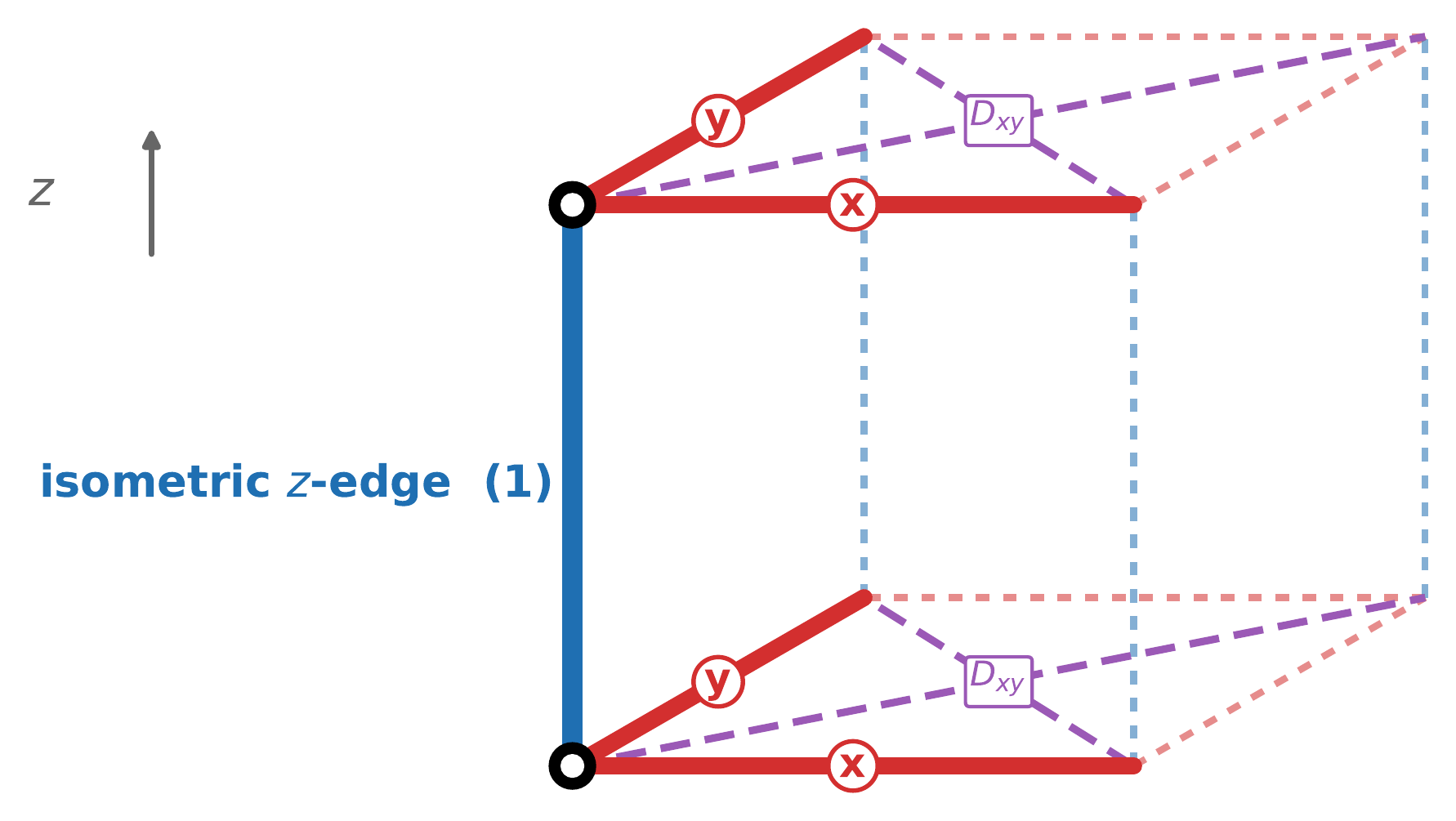
the closed star of an isometric edge (five edges), carried at ξ* per bond. The weights are conductances, inverse to length, and the disentanglers deliver the star's strength through the face diagonals of length \(\sqrt{2}\), so the count enters the weight per unit diagonal, \(c_{D}=5/\sqrt{2}\,\xi^{*}\). The row sum is 4 on each in-plane edge and 0 on the z and temporal edges, so \(\omega_{k}=1.3928\) in-plane and \(\omega_{k}=1\) along z and τ. The weighted trace lowers to Σ\(_{V}=3.82333\), closing the constant,
The same deformed trace Σ\(_{V}=3.82333\) is the denominator of the Higgs spectral weight, tying the vacuum expectation value to gravity.