 Harmonic Entanglement Theory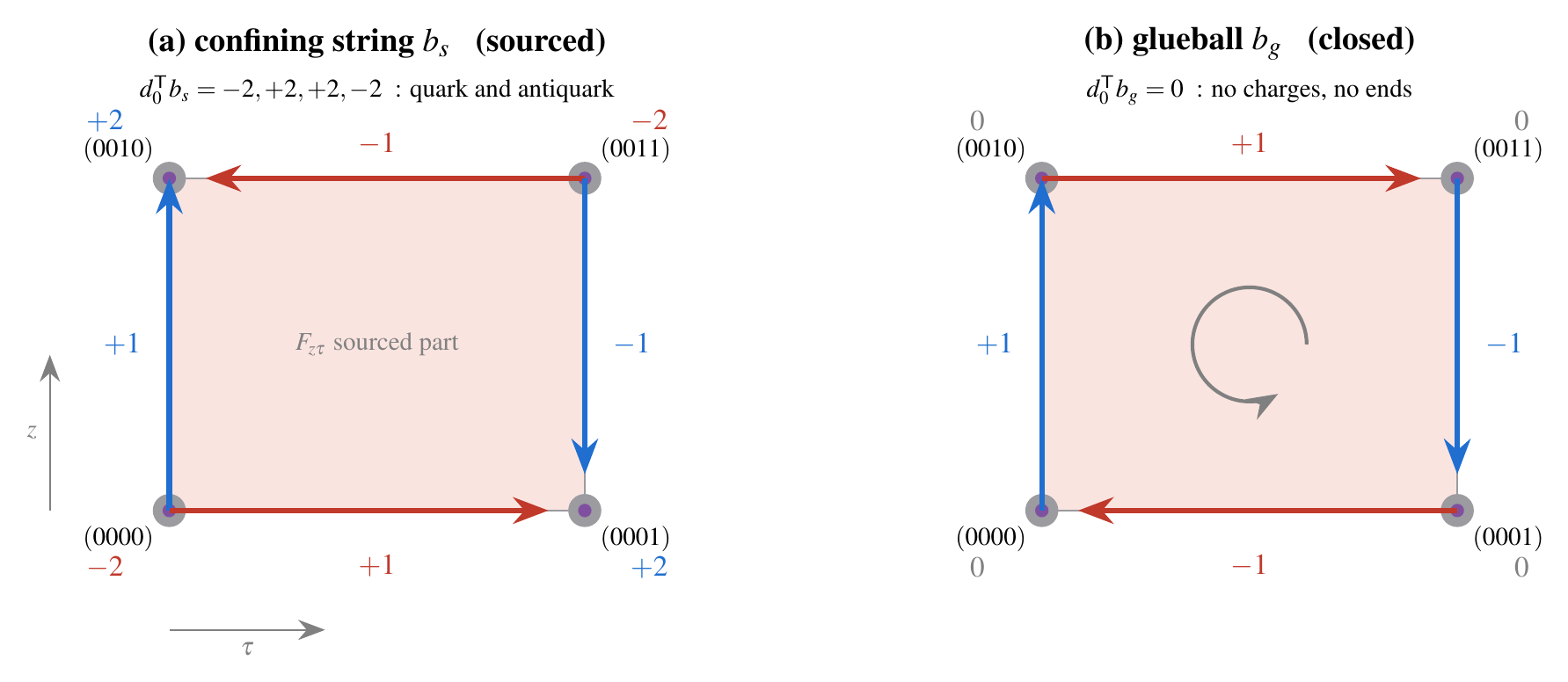
Closed flux on the same face
Where the string is the sourced part of the colour flux, the glueball is the closed part on the same face. Closure is the vanishing of the net flow at every vertex, \((d_0^{\mathsf T}b_g)_v=0\), which is exactly the kernel of the edge operator: since \(L_1=d_0 d_0^{\mathsf T}\), \(L_1 b=0\iff d_0^{\mathsf T}b=0\). The edge space splits into the seventeen-dimensional kernel of closed contours and the sourced eigenspaces \(\lambda=2,4,6,8\). On the prism only the \(z\tau\)-face can carry a closed colour contour, the circulation \(b_g\).
Sourcedness fixes the trace
The representation factor \(\Theta\) is a ratio of state-space dimensions, and confinement decides which channels are open. The confining string carries fundamental colour, so it propagates through the octet of eight gluons, \(\Theta_{b_s}=3/8\). The glueball is a colour singlet, and a singlet does not propagate through gluons, which confinement removes from the physical spectrum; its channels are hadronic. For the scalar there are four, the two-pseudoscalar channels of the light nonet, \(\pi\pi\), \(K\bar K\), \(\eta\eta\), and \(\eta\eta'\), so \(\Theta_{b_g}=1/4\). Through the master equation with the spectral weight squared,
The octet is internal to the construction, the colour assigned to the \(z\)-edges of the gauge sectors; the four hadronic channels are those of the light quark nonet and are not derived here.
in agreement with the quenched lattice scalar glueball \(m(0^{++})=1730(50)(80)\) MeV from the anisotropic Wilson action.
The note
The full derivation is set out in a short companion note.