 Harmonic Entanglement Theory
Gauge sectors on the cube
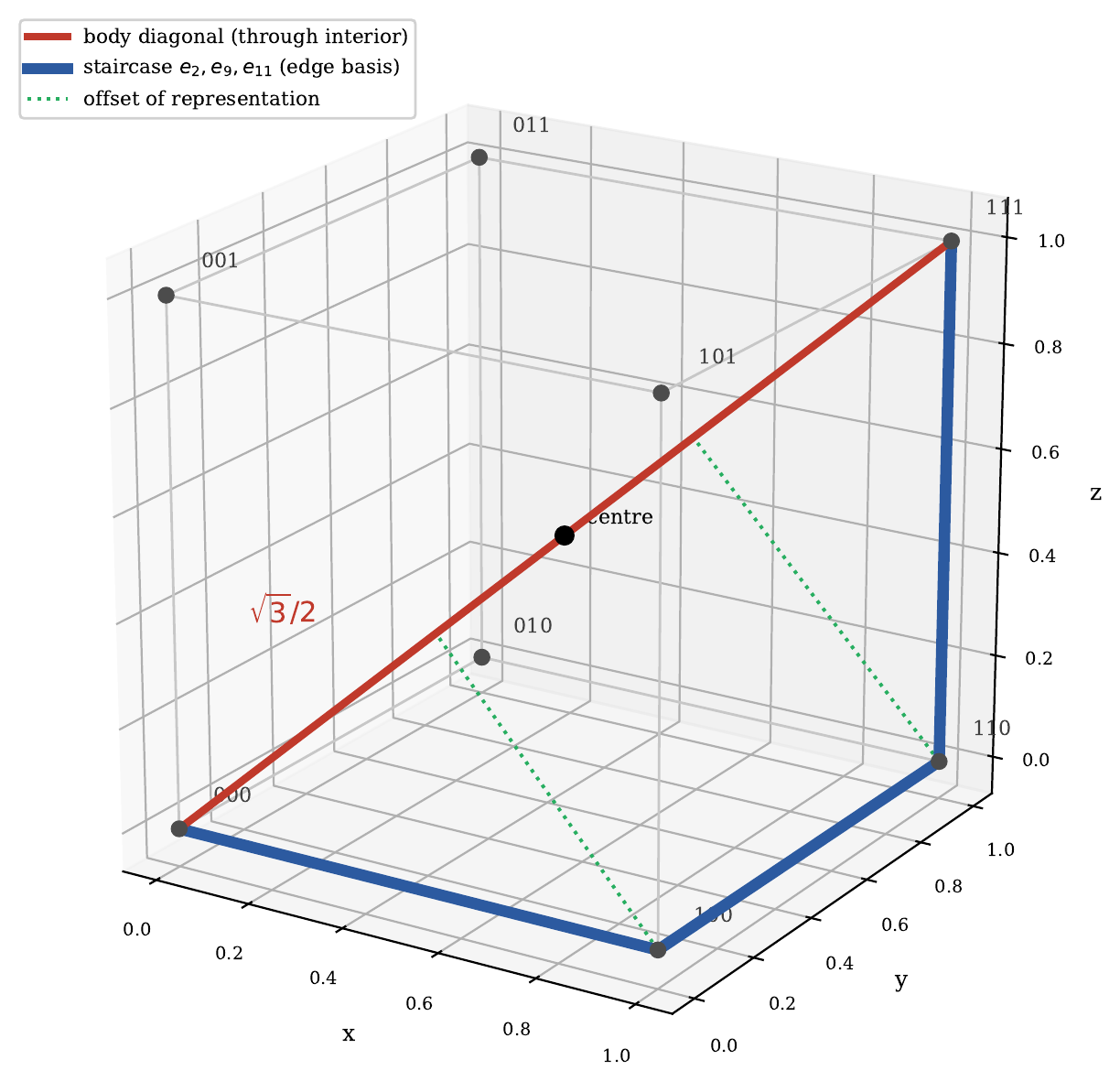
The \(1{+}2\) split partitions the twelve edges of \(Q_3\) into two bundles: the matching bundle \(E_z\), the four edges parallel to the isometric \(z\)-axis, and the disentangler bundle \(E_{xy}\), the eight edges parallel to \(x\) or \(y\). A third substrate is the body diagonal, the open line from \((000)\) to \((111)\) joining the antipodal corners through the cube. The three Standard-Model factors are carried by Wilson observables on these substrates: a closed loop on a face, a closed contour on the matching bundle, and an open line on the body diagonal.
The Wilson contour is the signed bond-field sum \(\sum_{e\in C}b_e\phi_e\). A closed contour, \(\partial_1 b=0\), measures the gauge-invariant flux through the surface it bounds. An open contour is sourced at its two endpoints, where the external charges sit. The abelian factor is the open line; the two non-abelian factors are the two closed substrates.
U(1)Y, the body diagonal. The abelian factor crosses all three axes once and joins \((000)\) to \((111)\). Under the residual disentangler symmetry \(\sigma_{xy}\), which swaps the \(x\) and \(y\) axes and fixes \(z\), both endpoints are fixed, so the diagonal is invariant. In the edge basis it is the staircase \((000)\to(100)\to(110)\to(111)\), three edges one along each axis, carrying the circumradius weight \(\sqrt3/2\) of the through-centre diagonal.
SU(2)L, the face loops. The first non-abelian factor is the closed four-cycle bounding an \(xy\)-face. All four of its edges lie in the disentangler bundle, so the weak loop is supported entirely on the disentangler plane. The face is a nontrivial closed cycle enclosing flux, so the weak loop carries a nonzero correction. Under \(\sigma_{xy}\) the two horizontal faces are fixed and the four vertical faces are paired; the two \(xy\)-faces give the same Wilson exponent.
SU(3)c, the matching bundle. The second non-abelian factor is \(E_z\), the isometry direction. The four \(z\)-edges meet each of the eight vertices of \(Q_3\) exactly once, so the only closed contour supported on \(E_z\) is the trivial one and the strong observable carries no correction from the bond action. Under coarse-graining the adjoint map carries \(E_z\) to the matching bundle of the next layer, so the colour substrate is an invariant subspace at every scale.
\[ SU(3)_c\times SU(2)_L\times U(1)_Y. \]
Plaquette identification
At the Planck scale two distinct structures coincide on every plaquette of \(Q_3\): Bekenstein–Hawking bond saturation, with \(D_{\mathrm{KL}}\) approaching \(\log\chi=1/4\), and Wilson lattice matching at spacing \(a=\ell_P\). Both govern per-plaquette quadratic fluctuations at the same scale.
On the Wilson side, the lattice action with link variables \(U_{ij}=\exp(i\xi_{ij}^{a}T^{a})\in SU(N_c)\) and \(\operatorname{tr}(T^aT^b)=\delta^{ab}/2\) is
\[ S_W=\frac{2N_c}{g^{2}}\sum_{\square}\Bigl(1-\tfrac{1}{N_c}\operatorname{Re}\operatorname{Tr}U_{\square}\Bigr). \]
Expanding \(U_{\square}=\exp(i\Omega_{\square}^{a}T^{a})\), the quadratic part of the plaquette is \(\Omega_{\square}^{2}/(4N_c)\), which fixes the coupling normalisation
\[ S_W=\frac{1}{2g^{2}}\sum_{\square}\Omega_{\square}^{2}. \]
At the Gaussian fixed point the entanglement action carries no vertices beyond the quadratic, so this is the bond action in the flux variables and the vacuum measure is Gaussian in the \(N_c^{2}-1\) adjoint components. For each component independently \(\langle\Omega_{\square}^{a}\Omega_{\square}^{b}\rangle=g^{2}\delta^{ab}\), so the plaquette flux per adjoint component is \(\langle(\Omega_{\square}^{a})^{2}\rangle=g^{2}\).
On the entanglement side the central identity gives the plaquette-averaged entanglement at the saturated fixed point,
\[ \langle D_{\mathrm{KL}}\rangle_{\square}=S^{*}\bigl(1+(\log\chi)^{2}\bigr)=g^{2}(m_P). \]
Both sides measure the per-plaquette deformation from the symmetric reference, so they are identified:
\[ \langle(\Omega_{\square}^{a})^{2}\rangle=\langle D_{\mathrm{KL}}\rangle_{\square}. \]
The bare couplings
Before the disentangler deformation, each sector is read from its matching vector through the bond action with diagonal pinning alone. A closed contour uses the recurrent formula, an open line the transient one.
Strong. The incidence vector on the matching bundle is \(b_s=c_1e_0+c_2e_5+c_3e_8+c_4e_{11}\). Closure reduces to one one-term equation per vertex, so every coefficient vanishes and
\[ b_s=0,\qquad \delta_s=\tfrac12\,b_s^{\mathsf T}M^{-1}b_s=0,\qquad g_s^{2}(m_P)=g^{2}(m_P). \]
The strong coupling is therefore carried unmodified from the plaquette identification; the residual against measurement is the gap between the two.
Weak. The face loop at \(z=0\) in canonical orientation \((000)\to(100)\to(110)\to(010)\to(000)\) gives
\[ b_L=(0,-1,+1,0,0,0,-1,0,0,+1,0,0)^{\mathsf T},\qquad |b_L|^{2}=4. \]
The loop is closed, so the recurrent formula applies:
\[ g_{L,\mathrm{bare}}^{2}(m_P)=\frac{g^{2}(m_P)}{1-1/16}=\frac{16}{15}\,g^{2}(m_P). \]
Hypercharge. The staircase edges carry the contour in positive orientation, weighted by the circumradius \(\sqrt3/2\) of the through-centre diagonal,
\[ b_Y=\frac{\sqrt3}{2}\,(0,0,1,0,0,0,0,0,0,1,0,1)^{\mathsf T},\qquad |b_Y|^{2}=\tfrac94. \]
With the diagonal pinning \(M_{ee}=\kappa_P=32\) alone, \(\delta_Y^{\mathrm{bare}}=|b_Y|^{2}/(2\kappa_P)=9/256\). The body diagonal is a Wilson line, so the transient formula applies:
\[ g_{Y,\mathrm{bare}}^{2}(m_P)=g^{2}(m_P)\Bigl(1-\frac{9}{256}\Bigr)=g^{2}(m_P)\cdot\frac{247}{256}. \]
The disentangler, the isometry, and their composite
Three operators act on the twelve edges. The disentangler \(D_{xy}\) acts on the eight in-plane edges through the face adjacency and the face-diagonal projector,
\[ D_{xy}=A_{xy}+2\,P_{xy}^{\square}. \]
The isometric incidence \(I_z\) couples each \(z\)-edge to the in-plane edges meeting it, and the composite is their anticommutator,
\[ C=\{D_{xy},I_z\}=D_{xy}I_z+I_zD_{xy}. \]
These three enter the bond action at the single residual scale \(\xi^{*}=1/36\): \(c_I=4\xi^{*}\) is the open star of the \(z\)-edge, \(c_C=2\xi^{*}\) the two diagonal placements per face.
The entanglement oscillator bond action
With the disentangler on, the entanglement oscillator bond action on the twelve cube edges is the diagonal pinning deformed by the isometric incidence Iz and the disentangler–isometry composite C={Dxy,Iz} on the single scale \(\xi^{*}=1/36\),
\[ M_{Q_3}=\kappa_P\bigl[\,I_{12}+\xi^{*}\bigl(4\,I_z-2\,C\bigr)\,\bigr],\qquad \kappa_P=32. \]
The diagonal pinning \(M_{ee}=\kappa_{P}\) makes every deformation traceless, so each coefficient is an open count over the edges its operator reaches. \(c_{I}=4\,\xi^{*}\) is the open star of the z-edge under Iz: each z-edge meets four in-plane edges, two at each endpoint. \(c_{C}=2\,\xi^{*}\) is the placement count of \(D_{xy}=A_{xy}+2\,P_{xy}^{\square}\); the flip x↦1−x is an automorphism of \(Q_3\) exchanging the two face diagonals, so the two placements carry equal weight, and the composite block DB has row sum \(8=2\times4\), twice the incidence. Each is a geometric count carried at the residual capacity \(\xi^{*}=1/36\). The couplings are read through the matching-vector quadratic forms \(\delta_{G}=1/2\,b_{G}^{T}M_{Q3}\)−1bG with \(g^{2}=g^{2}(m_{P}).\)
The three sectors
Strong. The colour contour is empty on the cube, \(b_{s}=0\), so the strong coupling is unmodified, \(\delta_{s}=0\) and \(g_{s}^{2}(m_{P})=g^{2}(m_{P}).\)
Weak. The face loop is recurrent, \(\delta_{L}=1/2\,b_{L}^{T}M_{Q3}\)−1bL=0.070192 and \(g_{L}^{2}(m_{P})=g^{2}/(1-\delta_{L}).\)
Hypercharge. The body-diagonal staircase \(b_{Y}=\sqrt{3}/2(e_{2}+e_{9}+e_{11})\) is transient, \(\delta_{Y}=1/2\,b_{Y}^{T}M_{Q3}\)−1bY=0.041894 and \(g_{Y}^{2}(m_{P})=g^{2}(1-\delta_{Y}).\)
The bond action against the PDG data
The reference column is the PDG 2024 inputs \((M_{t}=172.57 GeV,\) \(M_{W}=80.369 GeV\), \(\alpha_{s}(M_{Z})=0.1180)\) run to mP via Buttazzo eq.(61); \(g_{Y}^{2}=3/5g_{1}^{2}\) is the physical hypercharge from the GUT-normalized g1. \(g_s^{2}(m_P)\) is the single input and closes by construction. The bare column is the diagonal pinning alone, \(g_{L,bare}^{2}=16/15g^{2}\) and \(g_{Y,bare}^{2}=247/256g^{2}\) at \(g^{2}=g_{s}^{2}(m_{P})\); the bond action column completes the deformation, predicting gL2, gY2, and sin2θW.
| quantity | PDG/Buttazzo reference | bare | bond action |
|---|---|---|---|
| gs2(mP) | 0.237350 | 0.237350 (input) | 0.237350 (input) |
| gL2(mP) | 0.255530 | 0.253173 (−0.92%) | 0.255268 (−0.10%) |
| gY2(mP) | 0.227535 | 0.229006 (+0.65%) | 0.227406 (−0.056%) |
| sin2θW(mP) | 0.47102 | 0.474939 (+0.83%) | 0.47114 (+0.025%) |
| MQ3=κP[ I12+ξ*(4 Iz−2 C) ] (bond action) | |||
Table 5. The three gauge couplings and the weak mixing angle at the Planck scale. gs2(mP) is the single input and closes by construction; the deformation predicts gL2, gY2, and sin2θW, with residuals against the reference column. The bare column is the diagonal pinning alone; the bond action column completes the deformation.