Harmonic Entanglement Theory
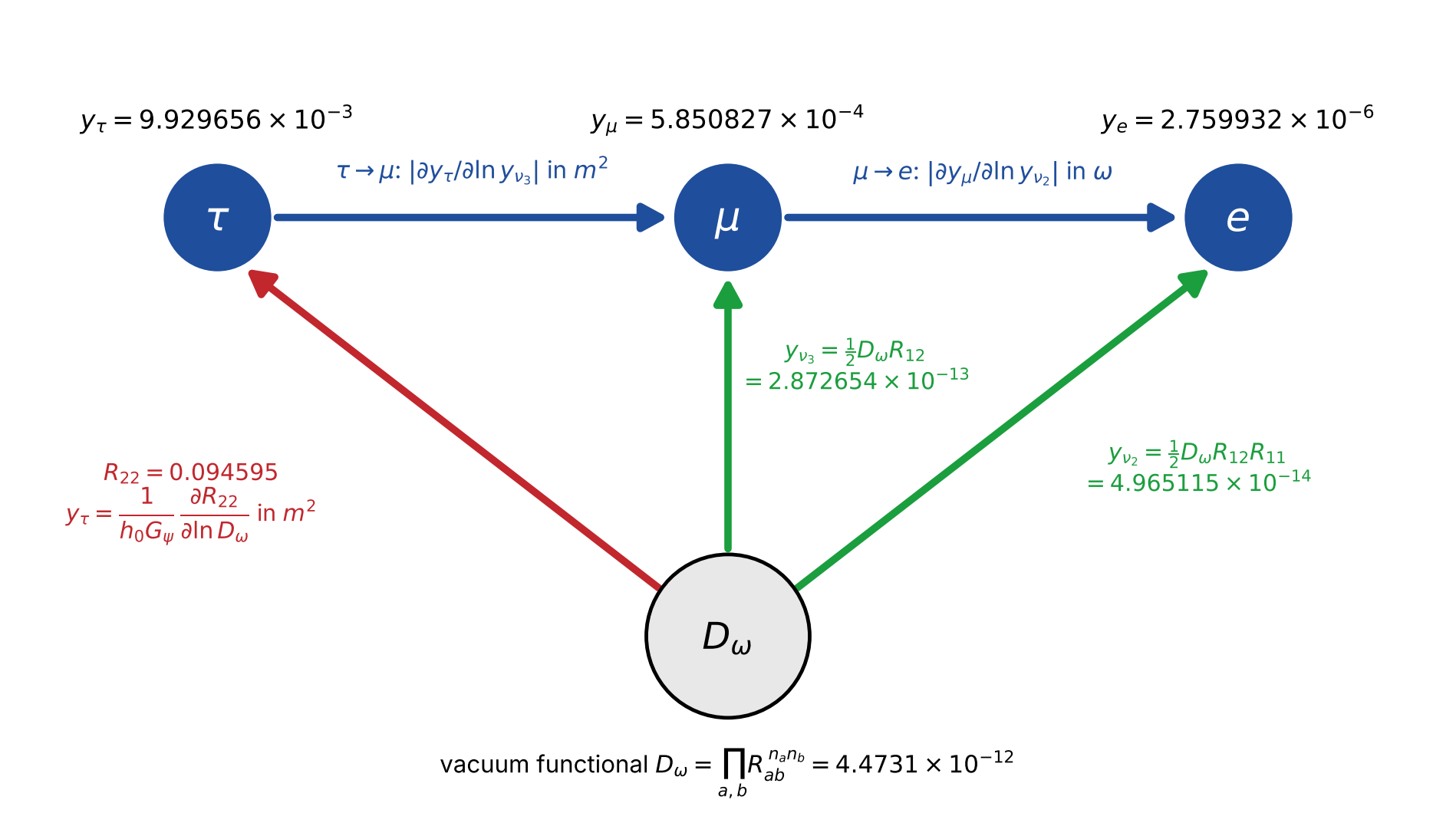
It is proposed that the three charged-lepton Yukawa couplings are carried by the vertex operator, through \(D_\omega\) and the cells of its spectrum (Section 10).
The Yukawa terms
The lepton Yukawa terms are (Weinberg)
\[ \mathcal L_Y=-Y^e_{ij}\,\bar L^iHe_R^j-Y^\nu_{ij}\,\bar L^i\tilde H\nu_R^j+\text{h.c.},\qquad \tilde H=i\sigma_2H^*,\qquad \langle H\rangle=h_0\begin{pmatrix}0\\v\end{pmatrix}, \]
each of total hypercharge zero.
| Yukawa term | hypercharge of L̅ | of the Higgs field | of the singlet | sum |
|---|---|---|---|---|
| L̅HeR | +1∕2 | +1∕2 | −1 | 0 |
| L̅H̃νR | +1∕2 | −1∕2 | 0 | 0 |
Table 1. The two lepton Yukawa terms and the Higgs field each carries.
The two members of each doublet \(L^i\) take their mass from opposite Higgs fields, the charged lepton from \(H\) and the neutrino from \(\tilde H\). Each charged-lepton Yukawa coupling is paired with the neutrino Yukawa coupling of its generation, the eigenvalues of \(Y^e\) and of \(Y^\nu\) each ordered by size, \(y_\tau\) with \(y_{\nu_3}\), \(y_\mu\) with \(y_{\nu_2}\), \(y_e\) with \(y_{\nu_1}\).
With the vertex mass term \(m^2\) of \(M_{V,\omega}=L_{V,\omega}+m^2I_{16}\), \(m^2=1\), the cell factors and multiplicities of Section 10 are
\[ R_{ab}=\frac{1}{m^2+\lambda(a,b)},\qquad m_{ab}=\binom2a\binom2b,\qquad D_\omega=\prod_{a,b}R_{ab}^{\,m_{ab}},\qquad \Sigma_V=\sum_{a,b}m_{ab}R_{ab}, \]
and the neutrino Yukawa couplings are \(y_{\nu_3}=\Theta_\nu D_\omega R_{12}\), \(y_{\nu_2}=\Theta_\nu D_\omega R_{12}R_{11}\), \(y_{\nu_1}=\Theta_\nu D_\omega R_{12}R_{11}R_{22}\).
The two couplings of the vertex operator are the mass shift \(m^2\) and the \(x,y\) edge weight \(\omega\),
\[ \frac{\partial R_{ab}}{\partial m^2}=-R_{ab}^2,\qquad \frac{\partial R_{ab}}{\partial\omega}=-2a\,R_{ab}^2, \]
so that \(m^2\) acts on every direction of the prism and \(\omega\) on the \(x,y\) edges only. From \(\ln D_\omega=\sum m_{ab}\ln R_{ab}\),
\[ \begin{aligned} \frac{\partial\ln D_\omega}{\partial m^2}&=-\sum m_{ab}R_{ab}=-\Sigma_V, & \frac{\partial^2\ln D_\omega}{\partial(m^2)^2}&=\sum m_{ab}R_{ab}^2, & \frac{\partial^3\ln D_\omega}{\partial(m^2)^3}&=-2\sum m_{ab}R_{ab}^3,\\ \frac{\partial\ln D_\omega}{\partial\omega}&=-\sum m_{ab}\,2a\,R_{ab}, & \frac{\partial^2\ln D_\omega}{\partial\omega\,\partial m^2}&=\sum m_{ab}\,2a\,R_{ab}^2, & \frac{\partial^3\ln D_\omega}{\partial\omega\,\partial(m^2)^2}&=-2\sum m_{ab}\,2a\,R_{ab}^3 . \end{aligned} \]
The response of \(\ln D_\omega\) to the mass shift is minus the gravitational trace \(\Sigma_V\).
| coupling c | first derivative ∂cln Dω | ∂c∂m2ln Dω | ∂c∂2m2ln Dω |
|---|---|---|---|
| mass shift m2 | −3.823325616 | 1.613594919 | −2.302751786 |
| x,y edge weight ω | −4.873531092 | 0.821402333 | −0.307393214 |
Table 2. Derivatives of ln Dω, the relation above, at m2=1, ω=1+5√2/18.
τ
The \(\tau\) mass is the descent of the single mode of cell \((2,2)\), \((-1)^{x+y+z+\tau}\). The \(\tau\) is a singlet whose electric charge distinguishes \(\tau\) from \(\bar\tau\), one channel, \(\Theta_\tau=1/1=1\). Once the Higgs field takes its vacuum expectation value, the term \(-y_\tau\bar L H e_R\) becomes the mass term \(-y_\tau h_0v\,\bar\tau_L\tau_R\), which carries the two fermion fields \(\bar\tau_L\) and \(\tau_R\). The \(\tau\) mass therefore carries the spectral weight of its mode twice, \(p=2\), against the one Higgs field factor of \(v\), \(p=1\),
\[ m_\tau=m_P\,\Theta_\tau\,\Pi_{22}^{\,2}\,e^{-1/\xi^*},\qquad \Pi_{22}=\frac{R_{22}}{\Sigma_V}=\frac{0.094595312}{3.823325616}=0.024741631 . \]
With \(m_\tau=h_0\,v\,y_\tau\) the factors \(m_P\,e^{-1/\xi^*}\) cancel,
\[ y_\tau=\frac{m_\tau}{h_0v}=\frac{\Theta_\tau\Pi_{22}^{\,2}}{h_0\,\Theta_\psi\,\Pi_\psi}=\frac{R_{22}^2}{h_0G_\psi\,\Sigma_V},\qquad (h_0G_\psi)^{-1}=\sqrt2\times3, \]
the Higgs factor \((h_0G_\psi)^{-1}\) the doublet normalisation \(h_0^{-1}=\sqrt2\) times the Higgs mode weight \(G_\psi^{-1}=3\). With \(\partial_{m^2}R_{22}=-R_{22}^2\) and \(\Sigma_V=-\partial_{m^2}\ln D_\omega\),
\[ y_\tau=\frac{1}{h_0G_\psi}\,\frac{\partial_{m^2}R_{22}}{\partial_{m^2}\ln D_\omega}=\frac{3\sqrt2\,(0.094595312)^2}{3.823325616}=9.929656\times10^{-3}. \]
τ → μ
The lighter Yukawa couplings are
\[ y_\mu=\left|\frac{\partial y_\tau}{\partial\ln y_{\nu_3}}\right|_{c_\tau},\qquad y_e=\left|\frac{\partial y_\mu}{\partial\ln y_{\nu_2}}\right|_{c_\mu},\qquad \frac{\partial X}{\partial\ln Y}\bigg|_c=\frac{\partial_cX}{\partial_c\ln Y}, \]
each step differentiating a charged-lepton Yukawa coupling against the logarithm of the neutrino Yukawa coupling of its generation, in the coupling \(c_\tau\) or \(c_\mu\) of the vertex operator to which the heavier Yukawa coupling is least sensitive,
\[ c_\tau:\ \min_{c}\left|\frac{\partial\ln y_\tau}{\partial c}\right|,\qquad c_\mu:\ \min_{c}\left|\frac{\partial\ln y_\mu}{\partial c}\right|,\qquad c\in\{m^2,\omega\}. \]
The factor \(\Theta_\nu\) drops out of the logarithmic derivative. From
\[ \ln y_\tau=-\ln(h_0G_\psi)+2\ln R_{22}-\ln(-\partial_{m^2}\ln D_\omega) \]
and the relation above,
\[ \frac{\partial\ln y_\tau}{\partial c}=-2w_c(2,2)\,R_{22}-\frac{\partial_c\partial_{m^2}\ln D_\omega}{\partial_{m^2}\ln D_\omega}, \]
with \(w_c(a,b)\) the weight of the coupling \(c\) on the cell \((a,b)\) from the relation above, \(w_{m^2}(a,b)=1\) and \(w_\omega(a,b)=2a\), so \(w_{m^2}(2,2)=1\) and \(w_\omega(2,2)=4\).
| coupling c | −2wc(2,2)R22 | -∂c∂m2ln Dω/∂m2ln Dω | sensitivity ∂ln yτ/∂ c |
|---|---|---|---|
| mass shift m2 | −2(0.094595312)=−0.189190624 | 1.613594919/3.823325616=0.422039628 | +0.232849004 |
| x,y edge weight ω | −8(0.094595312)=−0.756762496 | 0.821402333/3.823325616=0.214839754 | −0.541922742 |
Table 3. Sensitivity of yτ to the two couplings. The smaller in magnitude is the mass shift, cτ=m2.
With \(\partial_{m^2}\ln y_{\nu_3}=\partial_{m^2}\ln D_\omega-R_{12}\),
\[ y_\mu=y_\tau\,\frac{-2R_{22}-\partial^2_{m^2}\ln D_\omega/\partial_{m^2}\ln D_\omega}{R_{12}-\partial_{m^2}\ln D_\omega}, \]
\[ y_\mu=9.929656\times10^{-3}\times\frac{0.232849004}{0.128441028+3.823325616}=5.850827\times10^{-4}. \]
μ → e
From \(\ln y_\mu=\ln y_\tau+\ln\partial_{m^2}\ln y_\tau-\ln\big(R_{12}-\partial_{m^2}\ln D_\omega\big)\),
\[ \frac{\partial\ln y_\mu}{\partial c}=\frac{\partial\ln y_\tau}{\partial c}+\frac{\partial_c\partial_{m^2}\ln y_\tau}{\partial_{m^2}\ln y_\tau}-\frac{\partial_c\partial_{m^2}\ln D_\omega+w_c(1,2)\,R_{12}^2}{\partial_{m^2}\ln D_\omega-R_{12}}, \]
with \(w_c(1,2)=1,2\) for \(c=m^2,\omega\), and
\[ \partial_c\partial_{m^2}\ln y_\tau=2w_c(2,2)\,R_{22}^2-\frac{\partial_c\partial^2_{m^2}\ln D_\omega\;\partial_{m^2}\ln D_\omega-\partial^2_{m^2}\ln D_\omega\;\partial_c\partial_{m^2}\ln D_\omega}{\big(\partial_{m^2}\ln D_\omega\big)^2}. \]
For \(c=\omega\), with Table 2,
\[ \begin{aligned} \partial_\omega\partial_{m^2}\ln y_\tau&=8R_{22}^2-\frac{(-0.307393214)(-3.823325616)-(1.613594919)(0.821402333)}{(3.823325616)^2}\\ &=0.071586184+0.010271456=0.081857640,\\ \partial_\omega\partial_{m^2}\ln D_\omega+2R_{12}^2&=0.821402333+2(0.016497098)=0.854396529,\\ \frac{\partial\ln y_\mu}{\partial\omega}&=-0.541922742+\frac{0.081857640}{0.232849004}-\frac{0.854396529}{-3.951766644}\\ &=-0.541922742+0.351548166+0.216206220=0.025831644 . \end{aligned} \]
| coupling c | ∂ln yτ/∂ c | ∂c∂m2ln yτ/∂m2ln yτ | neutrino term | sensitivity ∂ln yμ/∂ c |
|---|---|---|---|---|
| mass shift m2 | +0.232849004 | −1.744805697 | +0.412497033 | −1.099459660 |
| x,y edge weight ω | −0.541922742 | +0.351548166 | +0.216206220 | +0.025831644 |
Table 4. Sensitivity of yμ to the two couplings, the three terms of the relation above. The smaller in magnitude is the x,y edge weight, cμ=ω.
With \(\partial_\omega\ln y_{\nu_2}=\partial_\omega\ln D_\omega-2R_{12}-2R_{11}\),
\[ y_e=y_\mu\left|\frac{\partial_\omega\ln y_\mu}{\partial_\omega\ln D_\omega-2R_{12}-2R_{11}}\right|, \]
\[ y_e=5.850827\times10^{-4}\times\frac{0.025831644}{4.873531092+0.256882056+0.345681408}=2.759932\times10^{-6}. \]
The selection
The \(\tau\) cell was scanned over the nine cells \(R_{ab}\) in \((h_0G_\psi)^{-1}\partial_{m^2}R_{ab}/\partial_{m^2}\ln D_\omega\). Each step was scanned over the five derivatives \(\partial_{m^2}\), \(\partial_\omega\), \(\partial^2_{m^2}\), \(\partial^2_\omega\), \(\partial_{m^2}\partial_\omega\) and over the quantity it is taken against, none, \(\ln D_\omega\), \(\ln y_{\nu_3}\), \(\ln y_{\nu_2}\), \(\ln y_{\nu_1}\), and in the \(\mu\to e\) step also \(\ln y_\tau\). This gives \(5\times5\times5\times6=750\) two-step chains from each \(\tau\) cell and \(9\times750=6750\) combinations. Only one of the \(6750\) places \(y_\tau\), \(y_\mu\) and \(y_e\) within \(1\%\) of their values at \(M_Z\), the relation above. Of the \(750\) chains from \(R_{22}\), eight place \(y_\mu\) and \(y_e\) within \(10\%\). Taking each step against the neutrino Yukawa coupling of the heavier lepton's generation leaves \(25\) chains, of which one is within \(10\%\), and taking it as a first derivative in the least-sensitive coupling leaves that one chain.
| lepton | Yukawa coupling | prism value | reference value at MZ | residual |
|---|---|---|---|---|
| τ | (h0Gψ)−1 ∂ R22/∂ln Dω|m2 | 9.929656 × 10⁻³ | 9.93780 × 10⁻³ (Antusch et al.) | −0.082% |
| μ | |∂ yτ/∂ln yν3|m2 | 5.850827 × 10⁻⁴ | 5.85042 × 10⁻⁴ (Antusch et al.) | +0.007% |
| e | |∂ yμ/∂ln yν2|ω | 2.759932 × 10⁻⁶ | 2.77713 × 10⁻⁶ (Antusch et al.) | −0.619% |
Table 5. The charged-lepton Yukawa couplings from Dω and the cells of the vertex operator.