 Harmonic Entanglement Theory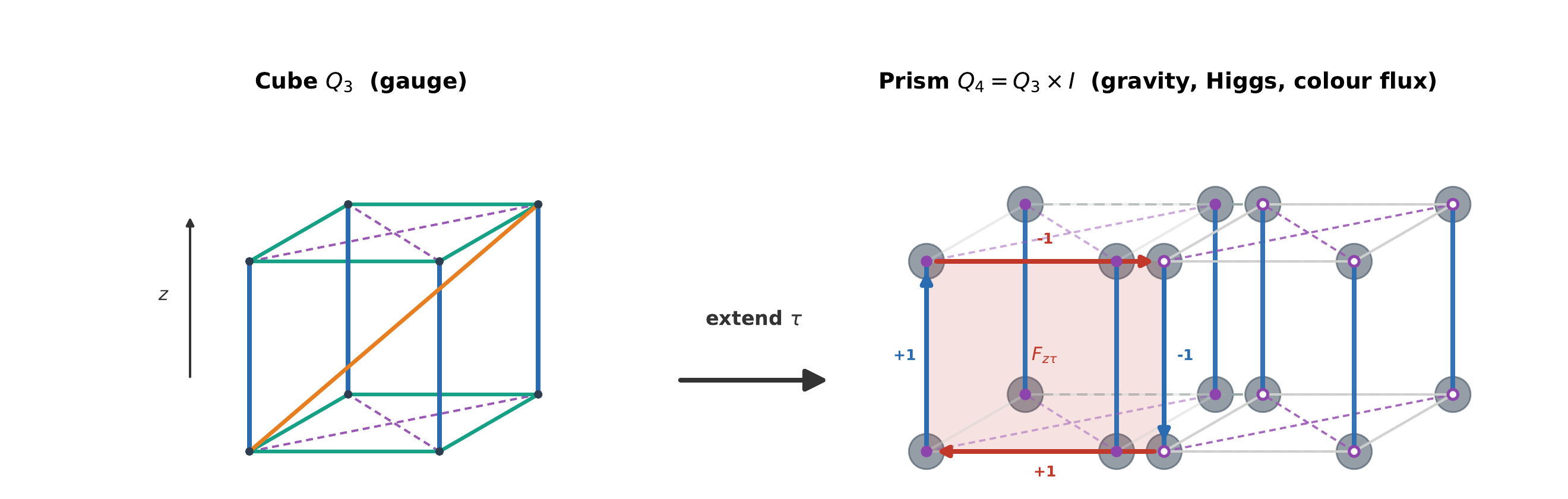
The construction
The vacuum is constructed as a network of entanglement bonds, one quantum harmonic oscillator on each Planck area of horizon, its coordinate the Umegaki relative entropy \(D_{\mathrm{KL}}\), saturating at the Bekenstein–Hawking bound \(\log\chi=1/4\). A binary MERA on the three-cube \(Q_3\) follows, fixed by that saturation and the dimensionality of space, giving the gauge cluster on \(Q_3\) and, through Sakharov's mechanism on the prism \(Q_4=Q_3\times I\), the gravitational constant.
The partition function gives the vacuum entanglement \(S^{*}=2/9\) and the residual capacity \(\xi^{*}=\log\chi-S^{*}=1/36\), the room the vacuum leaves below the bound. The eigenvalue scan selects the MERA and fixes \(g^{2}(m_P)=17/72\).
On the cube the three gauge sectors sit on the geometry: \(SU(3)_c\) on the \(z\)-edges, \(SU(2)_L\) on the \(xy\)-face loops, \(U(1)_Y\) on the body diagonal. On the prism the gravitational constant is the whole vertex trace, the Higgs field is the temporal vertex mode, and the colour flux on the \(z\tau\)-face carries the string tension in its sourced part and the glueball in its closed part. The same prism carries the fermion sector: each of the twelve Yukawa couplings is a chain on it from the doublet vertex through the Higgs edge and the gauge content of its Standard Model Yukawa term to the singlet vertex, and the quark and lepton Yukawa matrices read on it give the twelve fermion masses, the CKM and PMNS matrices, the flavour phase \(\theta_F\) and the CP phases.
| quantity | calculated | reference | residual |
|---|---|---|---|
| GN∕ℓP2 | 0.999057 | 1.000000 | −0.094% |
Induced on the prism by Sakharov's mechanism as the whole trace of the vertex operator, with the disentangler edge weights ωk curving it.
| quantity | calculated | reference | residual |
|---|---|---|---|
| v | 246.9 GeV | 246.22 GeV | +0.28% |
The Higgs is the temporal-alternating scalar mode of the same vertex operator that fixes GN, read through the descent relation at the first power. The reference is the Fermi-constant value.
| quantity | calculated | reference | residual |
|---|---|---|---|
| √σ | 422.4 MeV | 424.264 MeV | −0.44% |
The colour flux is a vector one-form on the zτ-face of the prism, spread over the edge operator and read through the descent relation with the spectral weight squared. The reference is √(0.18 GeV2) from the hadron spectrum.
| quantity | calculated | reference | residual |
|---|---|---|---|
| m0++ | 1732.34 MeV | 1730(50)(80) MeV | +0.14% |
The sourceless closed part of the same colour flux on the same face. The reference is the quenched lattice scalar glueball from the anisotropic Wilson action.
| quantity | calculated | reference | residual |
|---|---|---|---|
| yν3 | 2.872654 × 10⁻¹³ | — | — |
| yν2 | 4.965115 × 10⁻¹⁴ | — | — |
| yν1 | 4.696766 × 10⁻¹⁵ | — | — |
| Δm221 | 7.446588 × 10⁻⁵ eV2 | 7.49 × 10⁻⁵ eV2 | −0.58% |
| Δm231 | 2.514507 × 10⁻³ eV2 | 2.513 × 10⁻³ eV2 | +0.060% |
| Δm232 | 2.440041 × 10⁻³ eV2 | 2.43810 × 10⁻³ eV2 | +0.080% |
| ∑mν | 0.0596 eV | < 0.0642 eV | — |
The three Yukawa couplings carry no reference of their own, the masses following from them through the vacuum expectation value. They are the anchor Θν = 1∕2 times the determinant of the vertex operator over all sixteen modes, divided by one more cell factor of its spectrum for each generation. The references are NuFIT 6.0 and the DESI DR2 bound on the sum.
| quantity | calculated | reference | residual |
|---|---|---|---|
| yτ | 9.929656 × 10⁻³ | 9.93780 × 10⁻³ | −0.082% |
| yμ | 5.850827 × 10⁻⁴ | 5.85042 × 10⁻⁴ | +0.007% |
| ye | 2.759932 × 10⁻⁶ | 2.77713 × 10⁻⁶ | −0.619% |
The τ is the derivative of the (2,2) cell factor with respect to ln Dω. Each lighter charged lepton is the derivative of the heavier one with respect to the logarithm of its doublet partner’s Yukawa coupling, taken in the coupling the heavier lepton is least sensitive to — the vertex mass term for τ→μ, the x,y edge weight for μ→e.
| quantity | calculated | reference | residual |
|---|---|---|---|
| gs2(mP) | 0.237350 | 0.237350 | input |
| gL2(mP) | 0.255268 | 0.255530 | −0.10% |
| gY2(mP) | 0.227406 | 0.227535 | −0.056% |
| sin2θW(mP) | 0.47114 | 0.47102 | +0.025% |
This one takes a measurement in. With the measured strong coupling as input, the bond action on the cube returns the weak and hypercharge couplings and the weak mixing angle, so it is a check of the construction rather than a prediction from it — which is why the paper’s summary of results begins at GN. References are the PDG 2024 inputs run to the Planck scale.